Startup programs are the main reason a PC that was fast when new takes two minutes to become usable. Every application that adds itself to startup costs boot time and memory, and most of them do not need to be there.
Task Manager shows you which ones, ranked by how much they cost.
Checked August 2026. Applies to Windows 11 25H2 and Windows 10 22H2, where the menu names differ slightly — both are given below.
Task Manager: the main list
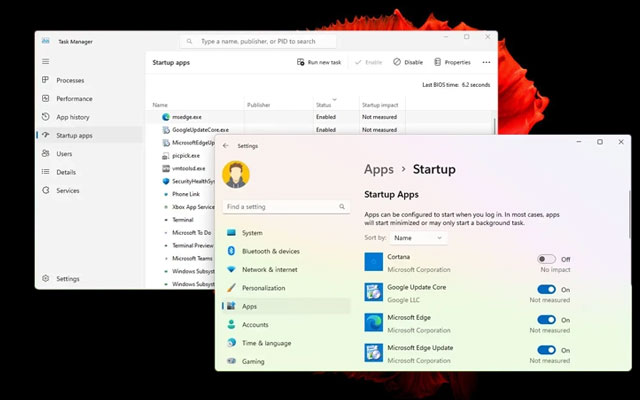
- Press Ctrl + Shift + Esc.
- Select Startup apps (Windows 11) or the Startup tab (Windows 10).
- Click the Startup impact column to sort.
- Select an entry and choose Disable.
Disabling is not uninstalling. The program stays installed and works normally — it just does not launch itself at sign-in. Everything here can be re-enabled in the same place.
Two columns worth reading
- Startup impact — High, Medium or Low, based on CPU and disk use during boot. Start with High.
- Publisher — if this is blank on something with a vague name, right-click → Open file location and see where it lives before deciding.
What to disable, and what to leave
| Usually safe to disable | Leave enabled |
|---|---|
| Spotify, Steam, Discord, Epic Games | Your antivirus or security suite |
| Adobe updater / Acrobat | Touchpad and hotkey utilities on laptops |
| Microsoft Teams, Skype, Zoom | Audio drivers (Realtek, Nahimic) |
| iTunes Helper, printer suites | Cloud sync you rely on (OneDrive, Dropbox) |
| Java Update Scheduler | VPN clients you need connected at boot |
| Vendor “assistant” apps | Anything with your device maker’s name that manages hardware |
The general rule: if you only use a program when you open it yourself, it does not need to start with Windows. If it manages hardware, protects the machine, or syncs data in the background, leave it.
Do not disable entries you cannot identify just because the impact is High. Search the exact file name first — RtkAudUService64.exe is your audio, not bloat. Disabling the wrong thing produces a machine with no sound, a dead touchpad, or a laptop that will not adjust brightness.
Settings has the same list
Settings → Apps → Startup.
Same entries, friendlier layout, and it shows the impact rating too. Use whichever you prefer.
The Startup folder
Some programs launch from a folder rather than a registry entry, and those do not always appear in Task Manager. To see it:
- Press Win + R.
- Type
shell:startupand press Enter.
Anything in this folder starts when you sign in. Delete a shortcut to stop it — you are deleting a shortcut, not the program.
For all users on the machine, use shell:common startup instead. You need administrator rights to change that one.
This folder is also the easiest way to add something to startup: put a shortcut in it.
Scheduled tasks — the ones people miss
Plenty of software avoids the startup list entirely by registering a scheduled task that runs at logon. Updaters do this routinely, which is why a program you disabled seems to come back.
- Press Win + R, type
taskschd.msc, press Enter. - Open Task Scheduler Library.
- Look for tasks triggered At log on or At startup.
Disable rather than delete, and leave anything under Microsoft alone — those are Windows’ own maintenance tasks.
Services
Services start before you sign in and are a level below startup apps. They are also where people do real damage, so treat this section as advanced.
Press Win + R, run services.msc. Third-party services from software you have removed or no longer use can safely be set to Manual.
Do not follow “services to disable in Windows” lists. They are written for a machine that is not yours, they go out of date with every Windows release, and disabling the wrong service breaks networking, printing, updates or audio in ways that are hard to trace back. Set services to Manual rather than Disabled, and only ones you can name.
How much difference does it make?
Honest expectations:
- On a machine with a mechanical hard disk: a lot. Boot time can halve, because startup programs are competing for a slow disk.
- On an SSD with plenty of memory: less than people expect. Boot may improve by a few seconds, but the desktop becomes responsive sooner, which is the part you actually feel.
- On a machine short of memory: significant, because those programs stay resident all day, not just at boot.
If the machine is still slow with a clean startup list, the cause is elsewhere — a mechanical drive, insufficient memory, or thermal throttling. See disabling animation effects for the other cheap win, though it is smaller than this one.
Frequently asked questions
Does disabling a startup program uninstall it?
No. It only stops it launching automatically. The program still works when you open it.
Something I disabled has come back.
Either the program re-added itself when you last ran it — updaters are the worst for this — or it also has a scheduled task. Check Task Scheduler for a logon trigger.
Is it safe to disable OneDrive at startup?
Yes, but understand the consequence: files stop syncing until you open it. If you rely on OneDrive backup, leave it. If you signed in once and never used it, disable it.
Why does Task Manager say High impact for something small?
The rating measures CPU and disk activity during startup, not the program’s size. A small updater that hammers the disk checking for a new version rates High.
Should I use a startup manager app?
No need. Task Manager, the Startup folder and Task Scheduler cover everything, and unlike third-party “optimisers” they will not disable something important on your behalf.
1 comment
Comments are closed on this guide.