VIDEO_DXGKRNL_FATAL_ERROR is a blue screen from the DirectX Graphics Kernel — the part of Windows that sits between applications and your graphics driver. When it appears, the graphics subsystem hit a state it could not recover from.
In practice this is a graphics driver problem far more often than a graphics card problem, and a clean driver reinstall fixes most cases.
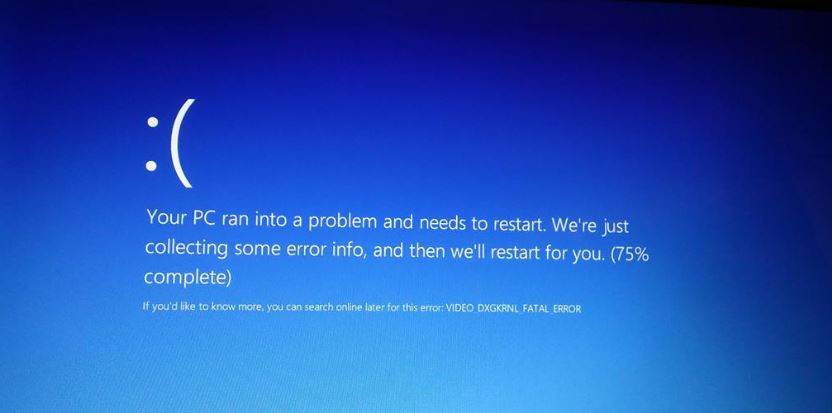
Checked August 2026. Applies to Windows 11 and Windows 10 22H2.
1. Clean-install the graphics driver
Not “update” — clean install. Installing over a damaged driver keeps the damage, which is why so many people report that updating did not help.
- Download first, while the machine still works: NVIDIA, AMD or Intel. On a laptop, prefer the system manufacturer’s build for your exact model.
- Boot into Safe Mode: Settings → System → Recovery → Restart now under Advanced startup → Troubleshoot → Advanced options → Startup Settings → Restart → press 4.
- Remove the existing driver completely. Display Driver Uninstaller (DDU) is the standard tool. The built-in equivalent is Device Manager → the display adapter → Uninstall device with Attempt to remove the driver ticked.
- Restart normally and install the driver you downloaded.
Both NVIDIA’s and AMD’s installers offer a “clean installation” checkbox. Use it.
2. Try the previous driver version
Newer is not always better. Graphics drivers ship monthly and occasionally introduce regressions for specific cards or games.
If the crashes started after a driver update, install the version before it — both vendors keep an archive of previous releases. Vendors also publish “Studio” or “Pro” branches that update less often and are more conservative; on a machine that must be stable, those are the better choice.
3. Remove any GPU overclock
Reset the core clock, memory clock and voltage curve to stock in MSI Afterburner or the vendor’s own tuning panel. An undervolt counts too — an unstable undervolt produces graphics crashes that look exactly like driver faults.
Many cards also ship with a factory overclock enabled by a switch or a profile in the vendor software. Set it to the reference profile while testing.
4. Check temperatures and power
- Temperature: monitor with HWiNFO under load. Above roughly 85 °C on the core is worth investigating; hotspot readings run higher. Clear dust from the card’s heatsink and confirm the case has airflow.
- Power: crashes only under load, on a machine stable at idle, often point at the power supply — particularly an ageing unit or one that is marginal for the card. Confirm every PCIe power connector is fully seated, and use separate cables rather than daisy-chaining where the PSU provides them.
5. Turn off hardware-accelerated GPU scheduling
This feature has been implicated in graphics-kernel crashes on specific driver and card combinations. It costs little to test:
Settings → System → Display → Graphics → Change default graphics settings → turn off Hardware-accelerated GPU scheduling, then restart.
If the crashes stop, leave it off and try again after a future driver release.
6. Repair system files
DISM /Online /Cleanup-Image /RestoreHealth
sfc /scannow
Reboot afterwards.
7. Read the crash dump
If the cause is still unclear, the dump usually names the driver directly.
- Install WhoCrashed or BlueScreenView.
- Open the newest file from
C:\Windows\Minidump.
dxgkrnl.sys named as the cause is expected — that is the component reporting the fault. What you are looking for is the driver named alongside it: nvlddmkm.sys for NVIDIA, amdkmdag.sys for AMD, igdkmd64.sys for Intel.
8. Test the card itself
If everything above fails, isolate the hardware:
- Use integrated graphics. Remove the card, plug the monitor into the motherboard, and use the machine for a day. No crashes strongly implicates the card.
- Reseat the card and its power connectors.
- Try a different PCIe slot, if the board has one.
- Try a different monitor cable. A failing DisplayPort cable can cause link training failures that surface as graphics crashes — cheap to rule out.
If Windows will not boot
When the crash happens before you can reach the desktop:
- Force the recovery environment by interrupting boot three times with the power button.
- Troubleshoot → Advanced options → Startup Settings → Restart → press 4 for Safe Mode.
- Uninstall the graphics driver from Safe Mode, then boot normally on Windows’ basic display driver and install a known-good version.
System Restore from the same recovery menu is often quicker — see using a restore point.
Frequently asked questions
Does this mean my graphics card is dying?
Usually not. Driver problems, overclocking and hardware-accelerated scheduling account for most cases. Suspect the card when a clean driver install at stock clocks still crashes, and when swapping to integrated graphics stops it.
What is dxgkrnl.sys?
The DirectX Graphics Kernel — the Windows component that manages GPU memory and scheduling between applications and the driver. It reports the fault; it is rarely the cause.
Why does it only crash in games?
Games are the only thing that stresses the GPU hard and continuously. Heat, power delivery and an unstable overclock all reveal themselves there first.
Is DDU necessary, or is Device Manager enough?
Device Manager with “attempt to remove the driver” is usually enough. DDU is more thorough — it clears registry entries and leftover files that the standard uninstall leaves behind — which matters when you have installed several driver versions over each other.
Can a monitor cable really cause a blue screen?
Yes, though it is uncommon. A marginal DisplayPort cable causing repeated link failures can crash the graphics stack. It is a two-minute test, so it is worth doing before buying anything.