Device Manager is where Windows lists every piece of hardware it can see, and where it tells you which pieces are not working. There are six ways to open it. The fastest is Win + X, then M.
This guide covers all six, plus how to read what Device Manager is telling you — which is the part that actually matters when you are troubleshooting.
Checked August 2026. Steps verified on Windows 11 25H2. They also work on Windows 10 22H2, though note that Windows 10 left support on 14 October 2025 and consumer Extended Security Updates end on 12 October 2027.
What Device Manager is for
Device Manager shows the hardware attached to your machine and the driver each piece is using. From it you can:
- See which devices have a problem, and what the problem is
- Update, roll back or uninstall a driver
- Disable a device without physically removing it
- Identify hardware Windows does not recognise
- Read the properties Windows needs for support — hardware IDs, driver versions and dates
It is a diagnostic and repair tool, not a settings panel. For changing how a device behaves — mouse speed, display resolution, sound output — use Settings instead.
The six ways to open it
1. Quick Link menu — fastest
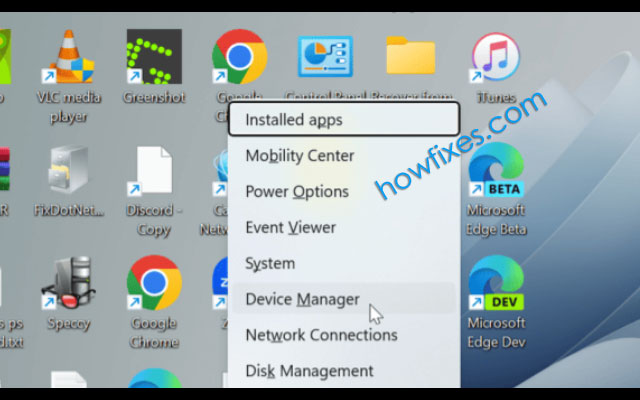
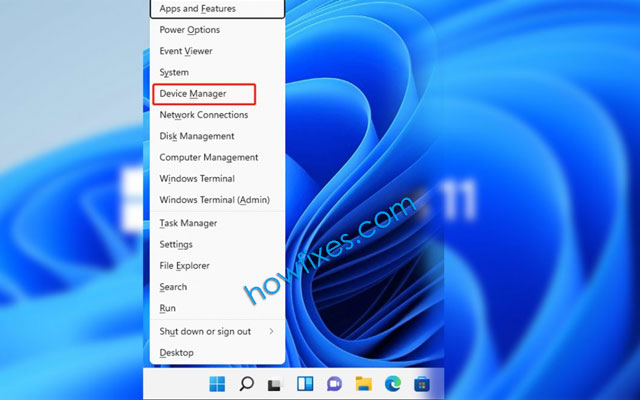
Press Win + X, then M. Or right-click the Start button and choose Device Manager.
Worth committing to memory — the same menu holds Disk Management, Terminal (Admin) and Event Viewer.
2. Start menu search
Press Win, type device manager, press Enter.
3. Run dialog
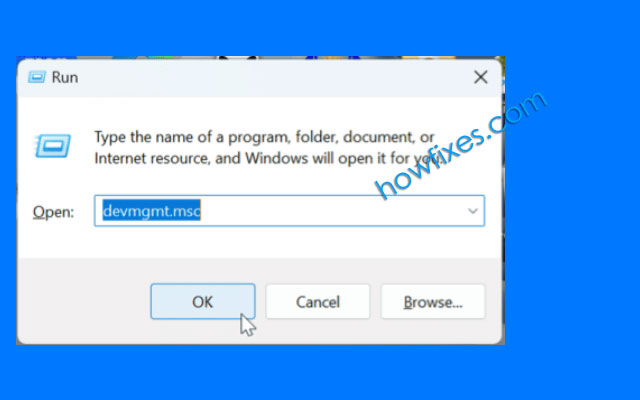
Press Win + R, type devmgmt.msc, press Enter. This is the one to use in written instructions, because it works identically on every Windows version.
4. Settings
Settings → System → About → Device Manager, under Related links.
5. Command line
From Command Prompt, PowerShell or Terminal, type devmgmt.msc and press Enter. Useful inside a script, or over a remote session.
6. File Explorer address bar
Open File Explorer, click into the address bar, type devmgmt.msc and press Enter.
Reading what it tells you
Opening it is the easy part. These are the symbols that matter:
| What you see | What it means |
|---|---|
| Yellow triangle with ! | The device has a problem. Open Properties for the error code. |
| Down arrow on the icon | The device is disabled, deliberately or otherwise. |
| Other devices category | Windows found hardware it has no driver for. |
| Unknown device | Windows cannot identify it at all — see below. |
Identifying an unknown device
This is the single most useful thing Device Manager does, and almost nobody knows about it.
- Right-click the unknown device → Properties.
- Go to the Details tab.
- In the Property dropdown, choose Hardware Ids.
- Right-click the top value and copy it.
You get something like PCI\VEN_8086&DEV_1502. VEN is the vendor ID and DEV is the device ID. Searching those two values names the exact chip, which tells you which driver to fetch.
Show hidden devices
View → Show hidden devices reveals hardware that is not currently connected but still has drivers installed. This is where to look for a ghost network adapter or an old printer causing conflicts.
Common tasks
Update a driver: right-click → Update driver. Note that Search automatically only checks what Windows already has and Windows Update — it will usually report the driver is up to date even when a much newer one exists on the manufacturer’s site. For anything that matters, download from the vendor and use Browse my computer.
Roll back a driver: Properties → Driver tab → Roll Back Driver. Available only if a previous version is still stored. This is the first thing to try when a device stops working right after an update.
Uninstall and reinstall: right-click → Uninstall device, then restart. Windows redetects most hardware and reinstalls the driver automatically. Tick Attempt to remove the driver only when you intend to install a different one.
Do not uninstall devices to “clean up” the list. Disk drives, display adapters and system devices are there because the machine needs them. If you are unsure what something does, leave it alone — and take a restore point before making driver changes.
If Device Manager will not open
- Nothing happens on Win + X: restart Windows Explorer from Task Manager, or sign out and back in.
- “MMC could not create the snap-in”: run
DISM /Online /Cleanup-Image /RestoreHealththensfc /scannowfrom an elevated prompt. - Blocked by policy on a work machine: that is intentional. Contact IT.
Frequently asked questions
What is the shortcut for Device Manager?
There is no single key combination, but Win + X then M is two keystrokes and works on Windows 10 and 11.
Is it safe to uninstall a device?
For most peripherals, yes — Windows reinstalls the driver on the next restart. Do not uninstall system devices, disk controllers or anything you cannot name. Take a restore point first.
Can Device Manager fix every hardware problem?
No. It manages drivers, so it fixes driver problems. Failing memory, a dying drive, an overheating GPU or a loose cable will not be resolved from here — though a device that vanishes and reappears in the list is often a hardware or cable fault rather than a driver one.
Do I need administrator rights?
You can open Device Manager and look at anything as a standard user. Changing a driver, disabling a device or uninstalling one requires administrator rights.
Device Manager says my driver is up to date, but it clearly is not.
“Up to date” means Windows has nothing newer in its own catalogue. Manufacturers ship drivers to their own sites months before — sometimes never — submitting them to Windows Update. For graphics cards especially, always check the vendor directly.