A MAC address identifies one network adapter on one local network. You need it for router allow-lists, for reserving a fixed IP by DHCP, and for the “register your device” pages that university and hotel networks use.
The fastest way to see all of them at once:
getmac /v /fo listThe rest of this guide covers the other routes, how to read the results, and the two things about MAC addresses that cause most of the confusion.
Checked August 2026 on Windows 11 25H2. All methods also work on Windows 10 22H2.
What a MAC address is
Every network adapter has a Media Access Control address burned in by its manufacturer: twelve hexadecimal digits, usually written as A4-BB-6D-2F-91-C0 or a4:bb:6d:2f:91:c0.
The point people miss: it belongs to the adapter, not to the computer. A laptop with wi-fi, Ethernet and Bluetooth has at least three different MAC addresses, and a machine with a VPN client or a virtual machine platform installed will have several more. Which one you need depends on how the machine is connected.
| MAC address | IP address | |
|---|---|---|
| Assigned by | The hardware manufacturer | The network (usually by DHCP) |
| Changes when you move network | No | Yes |
| Visible beyond your local network | No | Yes |
| Format | A4-BB-6D-2F-91-C0 | 192.168.1.42 |
Method 1: Settings
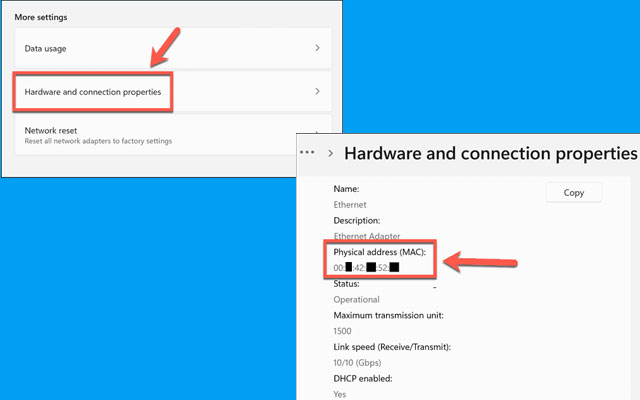
- Press Win + I to open Settings.
- Go to Network & internet.
- Select Wi-Fi or Ethernet, whichever you are using.
- Select the connection name, then Hardware properties.
Look for Physical address (MAC). This shows only the adapter you are currently connected through — which is usually the one you want.
Method 2: Command line — shows everything
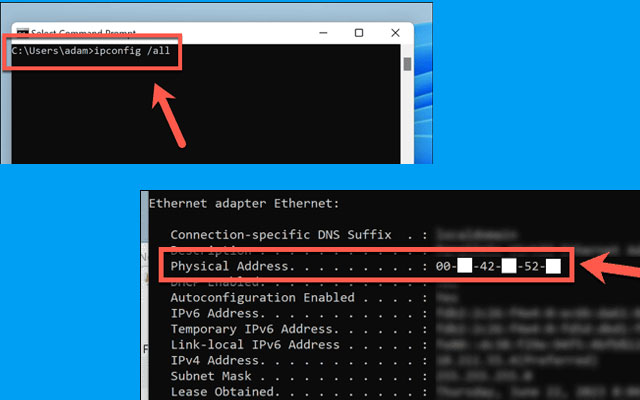
Open Command Prompt, PowerShell or Terminal — no administrator rights needed — and run:
getmac /v /fo listYou get every adapter with its connection name, description and physical address. The Transport Name line tells you which are actually connected: a disconnected adapter shows Media disconnected.
For more detail, including the IP address alongside each adapter:
ipconfig /allFind the section matching your connection and read the Physical Address line.
In PowerShell, for just the connected adapters:
Get-NetAdapter | Where-Object Status -eq 'Up' | Select-Object Name, MacAddress, LinkSpeedMethod 3: Bluetooth
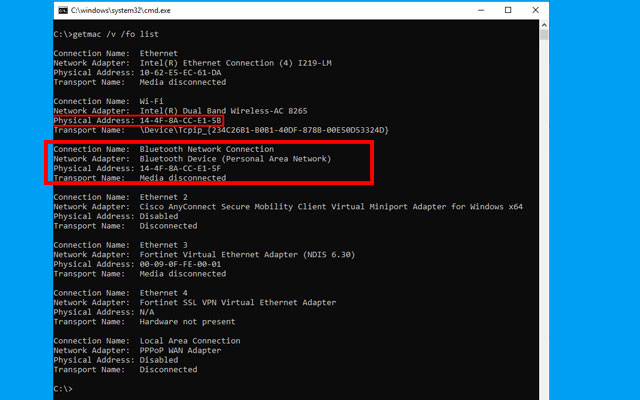
Bluetooth adapters have their own address, and Settings does not show it:
- Press Win + X, then M, to open Device Manager.
- Expand Bluetooth and double-click your adapter — the one with the manufacturer’s name, not the enumerator entries.
- Go to the Details tab.
- In the Property dropdown, choose Bluetooth device address.
Randomised MAC addresses on wi-fi
This is the thing that confuses people most, and it is worth understanding before you spend an hour on a router allow-list that will not stay working.
Windows 11 can use a random hardware address for wi-fi, either a different one per network or a new one periodically. It exists so that shops, airports and other public networks cannot track a device across visits by its permanent address — a genuinely good privacy default.
The side effect: the MAC address the router sees is not the one printed on the adapter, and it may change. An allow-list entry or a DHCP reservation will simply stop matching.
To check or change it:
- Settings → Network & internet → Wi-Fi.
- Random hardware addresses — the global switch.
- For one network: select the network → Use random hardware addresses → choose Off, On, or Change daily.
Turn it off for your home network if you use MAC filtering or DHCP reservations. Leave it on everywhere else — the privacy benefit is real and costs you nothing on networks you do not control.
A note on MAC filtering as security
Router MAC allow-lists are convenient for organising a home network. They are not a security measure. MAC addresses travel unencrypted in every wi-fi frame, so anyone within range can read an allowed address and set their adapter to match it in under a minute.
Use WPA3 — or WPA2 with a long, unique passphrase — for actual security. Treat MAC filtering as labelling, not as a lock.
Frequently asked questions
Which MAC address do I give the network administrator?
The one for the adapter you will connect through. On wi-fi, that is the wireless adapter; over a cable, the Ethernet one. If you are asked to register a laptop that uses both, give both.
Can a MAC address be changed?
The burned-in address cannot, but Windows can present a different one. Some adapters expose a Network Address or Locally Administered Address field under Device Manager → Properties → Advanced. Wi-fi randomisation is the same idea applied automatically.
Is a MAC address the same as an IP address?
No. The MAC identifies the hardware on the local network and never leaves it. The IP identifies the machine on a network and changes as you move between them.
Can someone track me by my MAC address over the internet?
No. MAC addresses are not carried beyond the local network segment — your router does not forward them. They can be used to track you within range of a wi-fi network, which is exactly what randomisation prevents.
Why do I see so many adapters in getmac?
VPN clients, virtual machine software (VirtualBox, VMware, Hyper-V, WSL) and Bluetooth all install virtual adapters, each with its own address. The ones showing Media disconnected are not in use.

1 comment
Comments are closed on this guide.