Rewritten August 2026. The previous version of this page was generic filler with no concrete steps. This one covers what actually exists: how to use Microsoft Copilot in Chrome, what the browser AI options are, and what to check before installing any of them.
Chrome has no built-in Microsoft Copilot. Microsoft builds Copilot into Edge, not into Chrome — so using it in Chrome means one of three routes, each with different trade-offs.
The three ways to get Copilot into Chrome
1. Use the web app — simplest, no permissions
Open copilot.microsoft.com in a tab and sign in with a Microsoft account.
To make it feel like part of the browser, install it as a web app:
- Open the site in Chrome.
- Three-dot menu → Cast, save and share → Install page as app.
It gets its own window and taskbar entry, and no extension has access to your browsing. For most people this is the right answer.
2. Install an extension — convenient, with a real cost
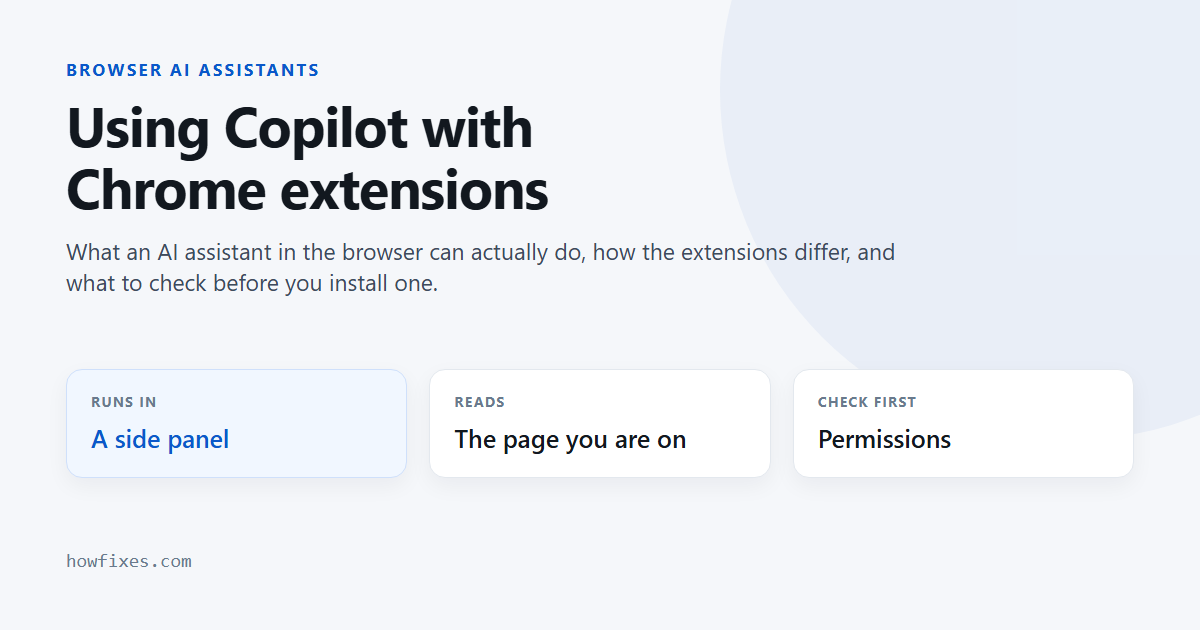
Extensions put Copilot in a side panel alongside whatever page you are on, so it can read and act on the current page.
That convenience is the whole trade: to summarise the page you are reading, an extension needs permission to read and change every page you visit. See the safety section below before installing one.
3. Use Edge for the tasks that need it
Unsatisfying but honest: Copilot in Edge is a first-party integration with no extension in between. Edge is built on the same engine as Chrome, so your extensions, bookmarks and passwords import in a couple of clicks.
Plenty of people keep Chrome as their main browser and open Edge for the few things where the built-in assistant earns its place.
Before installing any AI extension
Check the publisher. Microsoft publishes Copilot for Edge, not a Chrome extension. Anything in the Chrome Web Store called “Copilot” with a Microsoft-looking icon is third-party unless the listing genuinely names Microsoft Corporation as the publisher. Read the publisher field, not the icon.
Then check three things on the listing:
- Permissions. “Read and change all your data on all websites” is the broadest access Chrome grants. Only give it to a publisher you can identify.
- Recent reviews. Sort by newest and read the one-star reviews. Extensions get sold, and new owners push updates silently to everyone who already has it installed — a sudden cluster of complaints after years of praise is the signature.
- Site access after installing. Go to
chrome://extensions→ Details → Site access and set it to On click if the extension still works that way. It then does nothing on pages where you have not asked for it.
The wider guidance applies here too: how to choose an AI browser extension safely.
What an AI side panel is actually good for
- Summarising a long article before deciding whether to read it
- Explaining a page in a language or at a level you find easier
- Drafting a reply in a web form without switching tabs
- Explaining an error message you have just hit
- Comparing what is on two open tabs
And what it is not good for:
- Facts you will rely on. Summaries inherit any error in the source, and models add their own. Follow the citations.
- Anything confidential. Page content goes to the provider’s servers. That includes an internal document you happen to have open.
- Acting on your behalf. Treat any suggested command or setting change as a suggestion, not an instruction.
Chrome’s own AI features
Worth checking before installing anything: Google has been adding AI features directly to Chrome, and availability depends on your version, region and account. Look under Settings → AI innovations, or the equivalent section in your build.
A built-in feature needs no third-party permissions, which makes it the safer option whenever it covers what you need.
Keeping the browser fast
AI extensions run on every page and are among the more expensive ones. If Chrome slows down after installing a few:
- Press Shift + Esc for Chrome’s own task manager and sort by memory and CPU.
- Set site access to On click for anything you do not need constantly.
- Remove what you have stopped using — see how to speed up Chrome.
Frequently asked questions
Is there an official Microsoft Copilot extension for Chrome?
Microsoft builds Copilot into Edge. Check the publisher on any Chrome Web Store listing carefully — most results for “Copilot” are third-party.
Do I need a Microsoft account?
For Copilot, yes for most features. The consumer version is free; the version that can see your work files is a paid Microsoft 365 add-on. See using Copilot on Windows 11.
Can an extension read my banking pages?
An extension with access to all sites can read any page you open, including a bank. That is why the permission matters, and why “on click” access is worth setting.
Will an AI extension slow Chrome down?
Usually yes, to some degree — they run on every page. Chrome’s task manager shows exactly how much.
Is Copilot or ChatGPT better in the browser?
They are close. Copilot cites its sources more consistently, which matters when you intend to check an answer. ChatGPT has more tooling. Both work as a pinned web app with no extension at all.